
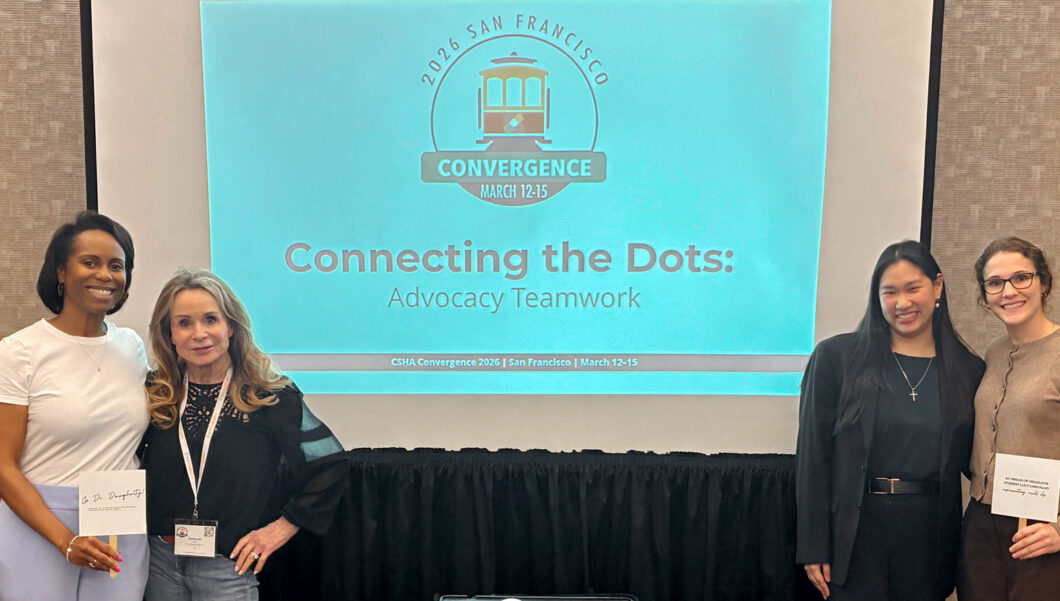
One year ago, when a mentor asked if I wanted to join a conference proposal, my first reaction was fear. My mind was immediately filled with questions: What would I present about? Who would I present with? When would I start preparing—how far in advance? Where would I present? What benefits would presenting at a conference bring to my career? Was I even qualified to give a presentation?
I had always felt that presenting at conferences was reserved for the “most accomplished” students and the “well-established professionals.” I never saw myself standing in front of a room of people who were eager to hear about my perspectives on a topic.
As students in communication sciences and disorders (CSD) professions, we have more to contribute than we might think. Through my first experiences preparing for and presenting at a conference, I learned that the process is much more approachable than it may seem.
Future presenters might have the same questions I had when I first started:
- What topic should I select?
- Who should I present with?
- When should I start preparing?
- Where (i.e., at which conference or event) should I present?
- Why should I present? What benefits would this experience bring for me as a CSD professional?
What should I present about?
Choosing a topic can feel like one of the hardest parts of preparing a proposal. When I began my first submission, I started by reviewing the conference topic areas and noting any subjects that interested me, even if I wasn’t an expert yet.
Although I already knew certain subjects in the list quite well, I wanted the process of preparing a presentation to be a learning experience for me, even as the presenter! Thus, the topic of leadership development initially stood out to me. Through follow-up conversations with my mentors and co-presenters, we narrowed our focus further, ultimately choosing advocacy as our subtopic.
I had earned some advocacy experience through National NSSLHA’s Student Advocacy Day, but I also knew that I had a lot to learn. That balance made it a compelling topic to explore and share with others.
Pro tip: Presentations often vary in length. For example, you can participate in oral seminars, poster presentations, and technical seminars. The commitment level and expectations vary for each format, so review the options when deciding on the category of your proposal submission.
Who should I present with?
Presenters can complete their presentations solo or alongside others. If you’re looking for people to present with, consider your professors, research advisors, classmates, and mentors.
For my advocacy presentation, I asked members of the National NSSLHA Executive Council to join me. They had been learning about advocacy alongside me, had participated in some of my first meetings with legislators, and shared my passion for leadership and advocacy.
As we began meeting and brainstorming together, the project quickly took shape. Collaborating on the presentation’s title, outline, and overall direction helped strengthen everyone’s investment in the project.
Pro tip: Don’t hesitate to ask. Even if someone cannot present with you,
they may have recommendations and connections that can offer you solid guidance and support.
When should I start preparing?
The timeline consists of two main elements: (1) the proposal timeline and (2) the timeline for preparing the actual presentation itself.
My proposal timeline looked like this:
- Week 1: Review the call for papers, and identify topics.
- Week 2: Meet with collaborators, and outline the proposal. Divide tasks into sections.
- Weeks 3 & 4: Draft and revise your assigned section.
- Week 5: Review your proposal, section by section, as a group. Finalize the proposal.
- Week 6: Submit your proposal!
My timeline for preparing the presentation itself is as follows:
- Several months before: Refine your proposal, and add content as needed.
- 4 months before: Start creating the presentation. The first step is putting each section of your proposal into a slide.
- 3 months before: Continue to work on your slides. First, focus on finalizing the content side of the presentation. Second, and only after that content side is complete, shift to working on the aesthetics of the presentation. Examples might include adding some appealing visuals, creating a clean, uncluttered page per slide (remember the value of white space!), and ensuring a consistent, recognizable look or “theme” across the presentation as a whole.
- 2 months before: Create a physical or digital (i.e., available via a scannable QR code on a screen at front) “handout.” This “handout” might be a resource page, a mini summary, or even a “homework” assignment that reminds attendees to carry this lesson back to their organizations and put what they learned into practice.
- 1 month before: Practice together, and rehearse your delivery either virtually or in person. On your own, you can practice presenting to your friends, pets, and family.
Pro tip: Think of your proposal as the foundation of your presentation. The stronger and more detailed your proposal is, the easier it will be to turn it into presentation-worthy slides later.
Where should I present?
You might wonder which conference or event you should choose as the one that you’ll submit your presentation to. Many conferences, including those with local, state, or national events (many of which recur around the same time every year, so they are predictable), accept proposals from students. A reliable starting point might be one of the conferences you’re already planning to attend anyway or those that align most closely with your professional interests. For example, you might consider an event organized by your local professional development association or membership organization.
At the start of the academic year, I usually have a general idea of which conferences I hope to attend. Some focus specifically on my clinical interests, whereas others cover a broader scope across the CSD professions. Because I would be attending these conferences anyway, I often decide to make the most of the opportunity by submitting a proposal to each one.
If you’re still exploring options, and you’re having trouble narrowing your focus, consider factors such as location, travel requirements, scheduling, and cost. You may also want to look into scholarships or funding opportunities to cover conference expenses.
Pro tip: Your university can be a logical place to start: I’ve had amazing experiences presenting research right here at my home university! Many schools host conferences on a variety of topics for students, faculty, and community members. Such localized conferences provide students with valuable, convenient, and cost-effective opportunities to practice presenting. Why not start honing your presentation skills in an environment that is known, comfortable, and familiar? Then, branch out from there.
Why should I present?
Presenting at conferences offers many career-enhancing benefits. Here are just a few:
- Strengthens your resume.
- Expands your professional network.
- Helps you develop valuable public speaking skills.
- Helps you deepen your knowledge of a topic.
- Enables you to contribute to important conversations in the CSD discipline.
As students, we bring perspectives shaped by emerging research, evolving technology, and our own experiences as future professionals. We’re uniquely equipped to actively participate in the conversations around evidence-based practice, technological changes, and so much more.
Preparing this presentation while balancing my responsibilities as a full-time student also helped me grow in unexpected ways. Here are just some of those ways:
- I learned more about teamwork and task delegation.
- I realized the importance of prioritizing large projects.
- I saw and felt how much the experience strengthened my friendships with my co-presenters, some of whom attend different schools and who otherwise wouldn’t be present in my daily or weekly work routine.
Pro tip: If you are presenting research, conferences may provide the space for new perspectives, interpretations, and feedback to strengthen your work.
Becoming an active participant in professional conversations can feel intimidating at first, but it’s an important step for your career. Presenting at conferences is one of the ways we can do this. It may be nerve-wracking at first (It definitely was for me), but like many new experiences, it becomes easier with practice. The growth that comes from the challenge makes it worthwhile.
If you’re considering submitting a conference proposal, I encourage you to take the leap. By choosing to present on and teach a topic to others, you may just be surprised at how much you learn in the process and how much you can help others to learn, too.