
As a student in communication sciences and disorders, you’ve probably learned about evidence-based practice (EBP) in the classroom. EBP is the cornerstone of clinical practice, and by using it, we’re ensuring that our decisions are backed by data, expertise, and patient values. However, applying EBP in the clinical setting comes with its own set of challenges.
When you’re juggling clinical rotations, classes, and exams, it can feel like a massive undertaking to sift through multiple databases, pull relevant research findings from dense academic texts, and then apply them to your specific client. Just when you start to feel oriented within the available literature, another new article is published. It’s hard to keep up, let alone find your footing.
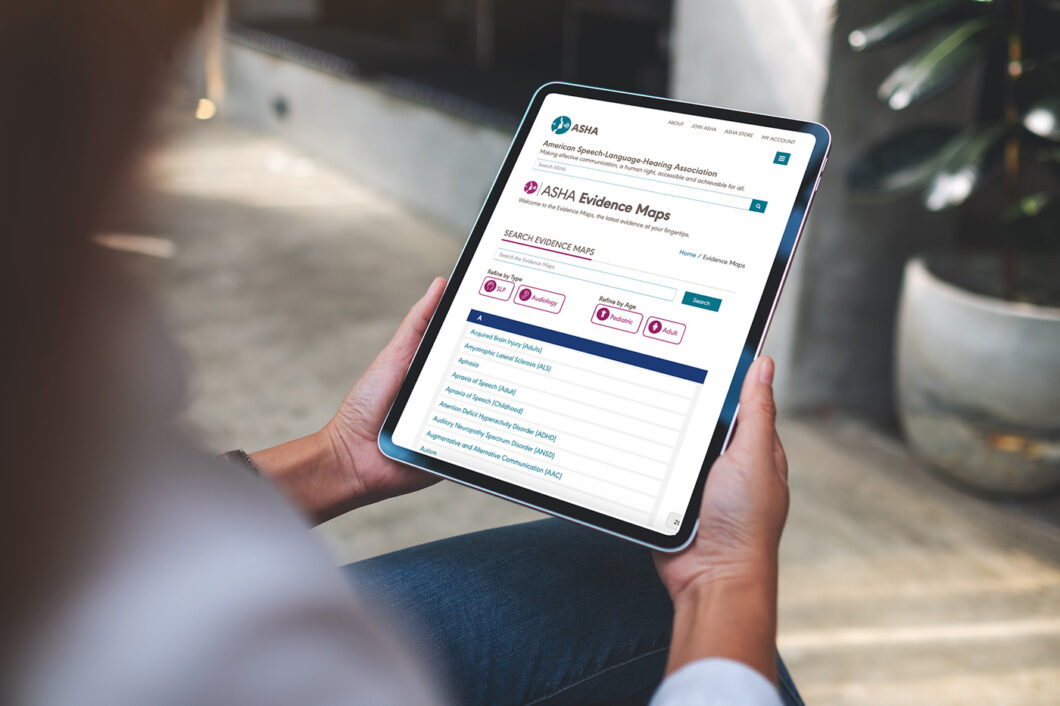
That’s where ASHA’s Evidence Maps comes in. This tool is not meant to replace the valuable clinical skills you learn when navigating the EBP process, but it can give you a head start. So, what is ASHA’s Evidence Maps? It’s a free, online tool that contains more than 4,000 article summaries across 60+ clinical topics, disorders, and populations.
What’s in a Map?
Covering topics that range from Acquired Brain Injury to Written Language Disorders, the Evidence Maps provides summaries of synthesized research—that is, research that gathers the results of multiple studies into one article to make overarching statements about a topic.
ASHA’s Evidence Maps houses three main types of synthesized documents:
- Systematic Reviews: These documents report quantitative or qualitative findings from multiple research articles obtained through a systematic search. When quantitative findings are similar enough, the study authors may conduct what is known as a meta-analysis to calculate an overall effect size.
- Clinical Practice Guidelines: These documents provide recommendations intended to optimize patient care. They are either evidence based (supported by systematic reviews) or consensus based (reflecting the collective opinions of subject matter experts).
- ASHA Practice Policy Documents: These consensus-based documents are written by ASHA members and approved by governance to promote best practices and standards in the professions.
To save time finding what you need, the Evidence Maps includes research directly relevant to audiology practice and speech-language pathology practice in the areas of screening, assessment, treatment, and service delivery.
How To Get Started: A Step-by-Step Tutorial
Visit apps.asha.org/EvidenceMaps.
- Find your topic.

On the home page, topics are organized alphabetically. You can narrow these topics by filtering for “Audiology” or “SLP” or by choosing an age group. You can also search across multiple topics by using keywords in the search box.
- Refine the results.
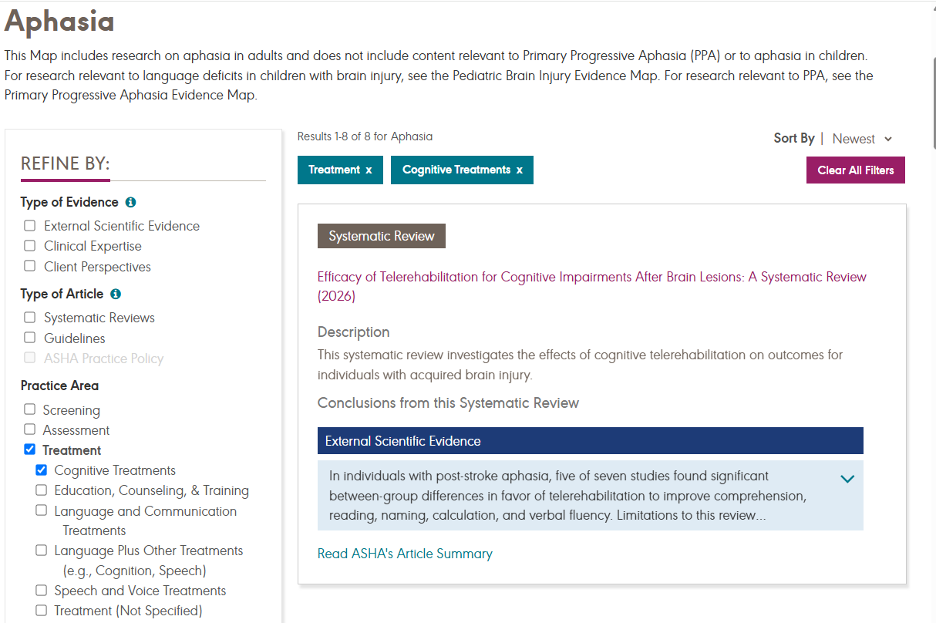
Once you choose a topic, you can use filters to find article summaries that best fit your clinical case. Generally, you can filter by:
- Type of Evidence (External Scientific Evidence, Clinical Expertise, or Client Perspectives) [based upon EBP principles]
- Type of Article (Systematic Reviews, Guidelines, or ASHA Practice Policy documents)
- Practice Area (Screening, Assessment, or Treatment)
- Service Delivery Considerations
- Additional Considerations (Client Characteristics, Treatment Outcomes, etc.)
- Publication Date Range
Some Evidence Maps contain additional filter options due to the unique nature of their content.
Pro Tip: Don’t over-filter. If you select Cognitive Treatments AND Stroke AND Timing AND Patient Satisfaction in the Aphasia Map, you run the risk of returning zero results. Instead, ask yourself which aspect of your clinical situation is most important, and start with the most relevant filters.
- View the Article Summary Page breakdown.
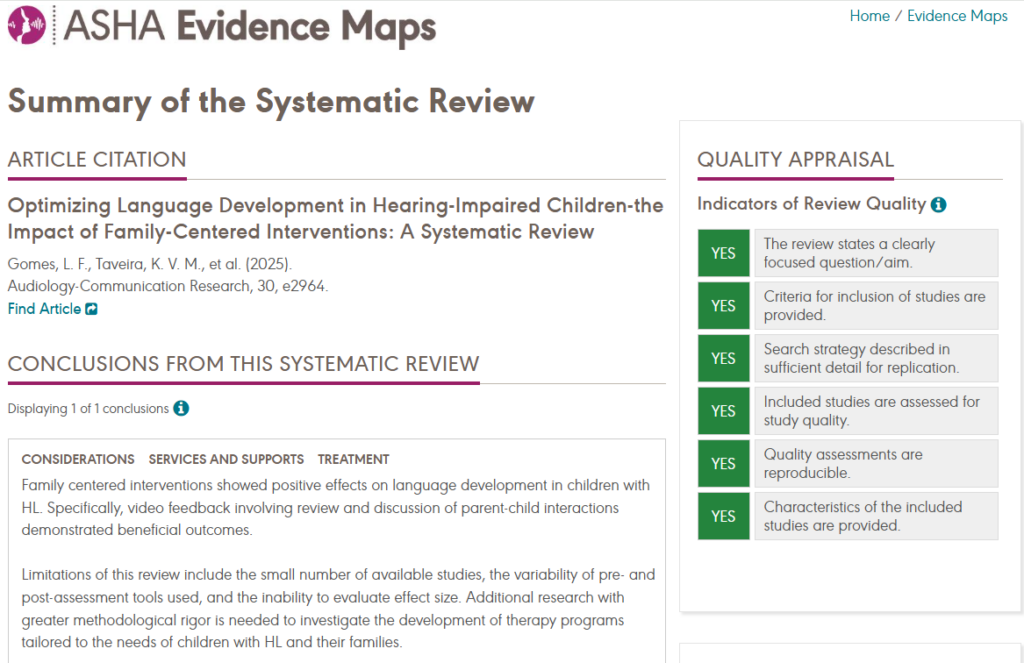
When you click into an article summary, you’ll see the following:
- Article Citation and Find Article Link: Each article contains reference information and a link to where the original article is published.
- As a NSSLHA member, you have access to full-text articles published in ASHA’s Journals—just sign in to your account.
- For articles published in other journals (not ASHA’s), some publishers offer free, open-access, full-text articles. Articles that are shown as being available only upon purchase may be available for free through your university library; so, check there first.
- See our resource on finding free-access research for more tips.
- Key Conclusions or Recommendations: Each article summary page summarizes key conclusions or recommendations.
- “Conclusions From This Systematic Review” presents the authors’ interpretation of their findings.
- “Recommendations From This Guideline” presents authors’ statements of what should or should not be done in clinical practice based upon a body of evidence and/or consensus.
- Article Details: For systematic reviews, the “Article Details” section includes a description of the article, years searched, study designs included, and more. For guidelines, the “Article Details” section includes a description and information about who sponsored the guideline. See screenshot below.

- Consider Quality Assessment.
Your next step is to consider the quality of the research: This is where the Evidence Maps beats an Internet search or an AI summary.
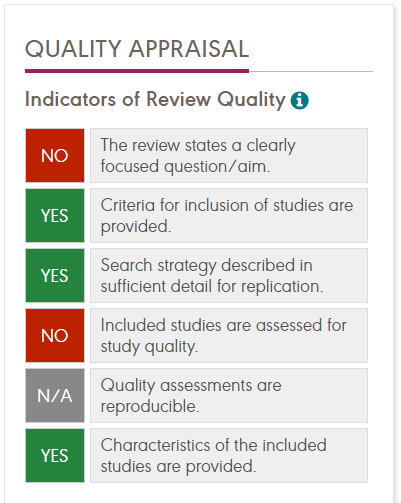
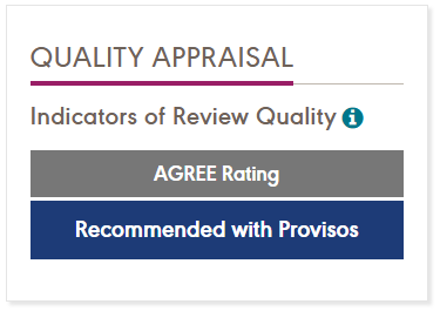
In curating and maintaining ASHA’s Evidence Maps, ASHA staff members appraise the methodological quality of each article to help you determine how much confidence you can place in the results. This is known as the Quality Appraisal (see screenshot below).
ASHA staff members appraise systematic reviews by measuring the published study against six quality indicators that show whether the systematic review . . .
- states a clearly focused question or aim;
- reports inclusion criteria for which studies would be accepted or rejected;
- describes the search strategy with enough detail that another researcher could repeat it;
- assesses the quality of the included studies;
- provides adequate details to replicate the quality analysis; and
- includes characteristics of both the participants and the intervention.
ASHA staff evaluate guidelines using criteria based on the principles of the Appraisal of Guidelines, Research, and Evaluation II framework—including scope and purpose, stakeholder involvement, rigor of development, clarity of presentation, applicability, and editorial independence. Only guidelines that are rated “Highly Recommended” or “Recommended With Provisos” make it into the Maps (see screenshot below).
A quick disclaimer: Inclusion in the Evidence Maps doesn’t guarantee that the original article’s underlying data, analyses, or conclusions are accurate or reliable. The quality ratings are there to help you identify limitations or methodology shortcomings that might influence the results.
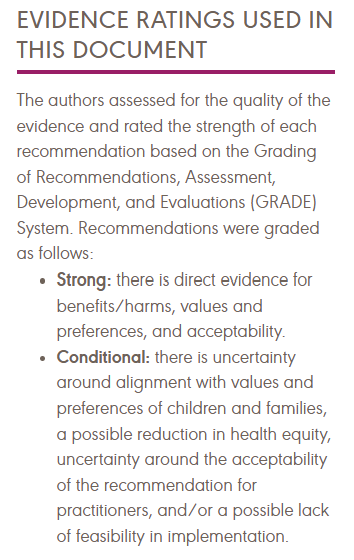
Articles may also include information about the levels of evidence supporting each conclusion or recommendation—if the authors have reported such evidence levels.
Evidence Map Q&A
Q: Does ASHA add its own interpretation to these summaries?
A: No. ASHA staff do not include any of their own views, interpretations, or additional analyses in these summaries. They only summarize what the original authors stated.
Q: How recent is the research?
A: ASHA staff review articles and publish summaries every week. Journal alerts and ongoing searches identify new articles for consideration in the Maps. Additionally, ASHA periodically conducts comprehensive searches for each Map—to identify any articles missed during the ongoing searches. Learn more about ASHA’s process.
Q: What if I can’t find evidence for my specific clinical case?
A: This happens! Sometimes, there is no synthesized research for a niche topic. In these cases, consider extrapolating evidence from similar populations, or turn to individual primary research studies. For more guidance, see Troubleshooting Common Obstacles to External Scientific Evidence.
Putting It All Together
Your time will always be a precious resource, even when you transition beyond the university clinic. You don’t have to be a professional researcher to practice evidence-based care—you just need to know where to look.
By using ASHA’s Evidence Maps, you can build confidence navigating the ever-changing landscape of clinical research. So, the next time a professor, a supervisor, or a patient asks you why you chose a particular intervention, you’ll be able to confidently explain the evidence that informed your decision. Start exploring ASHA’s Evidence Maps today—and let the evidence lead the way.
For more information, check out ASHA’s EBP webpage, or email ncep@asha.org.