
Effective care rarely comes from one professional working alone. Speech-language pathologists, audiologists, occupational therapists, psychologists, educators, physicians, and other professionals often bring different perspectives to the same client’s needs.
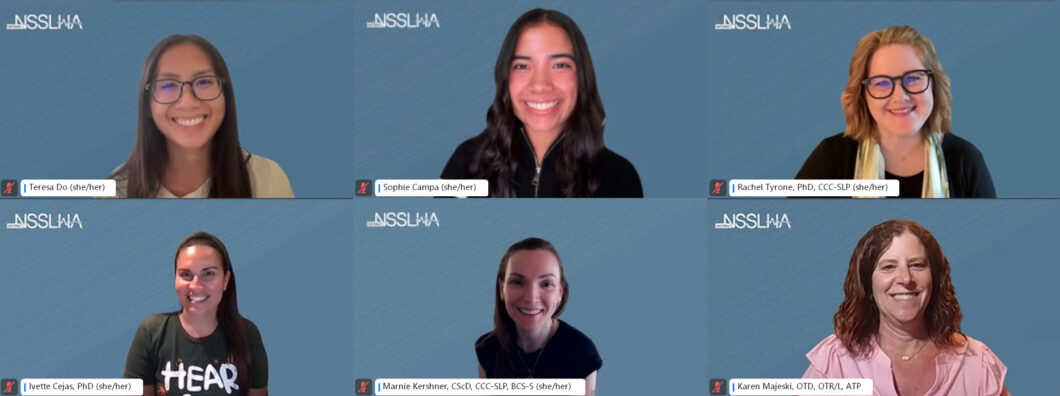
During National NSSLHA’s Raw Conversations: Building Bridges in Allied Health—A Collaborative Advocacy Forum event, professionals from across allied health discussed how students and clinicians can better understand one another’s roles, collaborate across disciplines, and advocate for the people and communities they serve.
Panelists included:
- Ivette Cejas, PhD, professor and director of Family Support Services at the University of Miami
- Marnie Kershner, CScD, CCC-SLP, BCS-S, director of inpatient speech-language pathology at MedStar National Rehabilitation Hospital
- Karen Majeski, OTD, OTR/L, ATP, program director of the Doctor of Occupational Therapy Program at Quinnipiac University
- Rachel Tyrone, PhD, CCC-SLP, assistant professor at the University of Mississippi Medical Center
Watch the full event:
1. Learn What Other Professionals Do
Understanding the roles and scopes of other professions is one of the first steps toward meaningful collaboration. However, panelists acknowledged that misconceptions about allied health fields are common—even among professionals who regularly work together.
For example, occupational therapy is sometimes reduced to fine motor skills or sensory work. In practice, occupational therapists help people participate in the activities that matter to them across their daily lives. Depending on the person and setting, this may include self-care, education, work, play, leisure, social participation, mobility, feeding, and other activities.
The panelists encouraged students not to rely on assumptions about another profession’s role. Instead, ask questions such as:
- What does this professional assess?
- What outcomes are they working toward?
- How does their expertise complement mine?
- Where do our scopes of practice overlap?
- When should I consult or refer to them?
- What can I learn by observing their approach?
Learning about other professions is not limited to students or early-career clinicians. Experienced professionals also encounter unfamiliar specialties, settings, and approaches. Strong team members remain curious and willing to learn throughout their careers.
Students can use the Interprofessional Education Collaborative’s Core Competencies to better understand the knowledge, values, and communication skills that support effective team-based care. ASHA also provides resources on interprofessional education and interprofessional practice.
Job shadowing, interprofessional coursework, shared clinical experiences, and conversations with students or professionals in other disciplines can help you build that understanding before entering the workforce.
2. Collaboration Can Take Many Forms
Interprofessional collaboration does not look exactly the same in every workplace. The structure of the team may depend on the setting, the professionals available, the needs of the client or patient, and the systems governing service delivery.
Panelists shared examples of collaboration that included:
- Speech-language pathologists and occupational therapists developing shared feeding plans
- Team members posting complementary strategies so everyone assisting a patient follows a consistent approach
- Multiple professionals observing an evaluation and sharing their perspectives
- Clinicians consulting one another when a concern falls outside their primary area of expertise
- Teams meeting before speaking with a family so they can provide clear, coordinated recommendations
- Professionals working together to advocate for services, funding, accommodations, or policy changes
Collaboration does not always require a formal team meeting. It can begin with a brief conversation, a question about another provider’s observations, or an invitation to review a shared concern.
However, effective collaboration requires more than having several disciplines involved in the same case. Team members must communicate, respect one another’s expertise, and work toward common goals.
Panelists emphasized the importance of keeping the client and family at the center of those conversations. Each professional may approach the situation from a different perspective, but the team should remain focused on what will best support the individual’s needs, preferences, participation, and quality of life.
The National Academies of Practice is one example of an organization that brings health care professionals together to advance interprofessional collaboration and practice.
3. Respect Scope of Practice and Know When to Refer
Working collaboratively does not mean that every professional should address every concern. Strong interprofessional practice depends on understanding your own scope of practice and recognizing when another provider has more appropriate expertise.
A clinician may identify a concern related to mental health, sensory processing, mobility, swallowing, hearing, communication, cognition, or another area without being the right person to evaluate or treat it independently.
In those situations, collaboration may involve:
- Consulting a professional from another discipline
- Asking whether a referral is appropriate
- Coordinating assessments or treatment plans
- Sharing relevant observations with permission
- Clarifying which professional should take the lead
- Remaining involved when your expertise is still relevant
- Transferring responsibility when the concern falls outside your scope
Referring to another professional is not a failure or a sign that you lack knowledge. It demonstrates ethical practice and a commitment to helping the client receive appropriate care.
Students can begin developing this skill by learning the boundaries of their future profession and becoming familiar with the roles of other team members. When you are unsure, ask a supervisor, educator, or qualified colleague rather than making assumptions.
Organizations focused on particular populations and areas of practice can also help students learn when interprofessional consultation may be beneficial. Examples discussed during the event included the Brain Injury Association of America, the American Association on Intellectual and Developmental Disabilities, the National Technical Assistance Center on Transition, and the Rehabilitation Engineering and Assistive Technology Society of North America.
4. Approach Conflict With Curiosity
Professionals do not always interpret a situation in the same way. Team members may have different recommendations because they are working from different areas of expertise, observing the person in different contexts, or prioritizing different aspects of care.
Those differences can be valuable. They may reveal needs that one professional would not have identified alone. However, disagreements should be handled thoughtfully.
One practical recommendation from the event was: Notice the conflict, acknowledge it, and engage with curiosity.
Panelists recommended that professionals discuss conflicting recommendations with one another before presenting them to a client or family whenever possible. These conversations give the team an opportunity to:
- Explain the reasoning behind each recommendation
- Identify areas of agreement
- Clarify misunderstandings about professional roles
- Review relevant evidence
- Consider the client’s and family’s priorities
- Develop a coordinated plan
- Determine how remaining differences will be communicated
Families should not be placed in the middle of unresolved professional conflict. Even when team members do not reach complete agreement, they can communicate respectfully and explain the available options without undermining one another.
Students may feel hesitant to raise a concern when speaking with a supervisor or more experienced professional. Panelists encouraged them to approach these conversations with curiosity rather than confrontation. Asking someone to explain their reasoning can create space for discussion while showing respect for their expertise.
5. Understand How Systemic Barriers Affect Access to Care
The panelists discussed how workforce shortages, limited funding, reimbursement policies, and other systemic challenges affect both professionals and the people they serve.
Funding and workforce challenges are closely connected: Funding affects the availability of professionals, and a lack of professionals limits access to care. The result can be a domino effect that contributes to larger caseloads, longer wait times, fewer available services, and gaps in care.
Panelists identified challenges that included:
- Workforce shortages
- High caseloads
- Limited funding
- Insurance and reimbursement requirements
- Gaps in access to services
- Increasing numbers of uninsured or underinsured patients
- Policies that do not reflect clinical realities
- Limited understanding of allied health professionals’ roles
Access to care is also influenced by the conditions in which people are born, live, learn, work, play, and age. ASHA offers resources to help students and professionals learn more about the social determinants of health.
The panel also recommended Mama Might Be Better Off Dead by Laurie Kaye Abraham as a resource for developing a better understanding of health disparities.
Recognizing these larger influences can help clinicians look beyond individual diagnoses and consider the barriers that may affect a person’s ability to access services, follow recommendations, or participate fully in care.
6. Advocate Across Professions
Advocacy can happen at many levels. It may involve helping one client access a needed service, educating colleagues about a profession’s role, requesting more appropriate staffing, or supporting changes to institutional, state, or federal policy.
Many challenges facing allied health professionals do not affect only one discipline. When professionals identify shared goals and advocate together, they can bring a broader range of expertise and a stronger collective voice to an issue.
Federal and state coalitions offer examples of professions and organizations working together around shared concerns. These include the Pennsylvania Speech-Language-Hearing Association’s Tri-Alliance and the national Coalition for Trust in Health & Science.
Effective advocacy should also be grounded in evidence. Understanding recommended caseloads, staffing ratios, treatment approaches, outcomes, and service-delivery models can help professionals explain why a change is needed.
Advocacy may begin with showing up, asking questions, and seeking a place in conversations where your profession’s perspective is missing. Students do not need to wait until they are established clinicians to become involved. They can learn about current issues, participate in professional organizations, attend legislative events, communicate with policymakers, and educate others about the needs of the populations they hope to serve.
Students can explore current policy issues and ways to participate through ASHA’s State Advocacy resources and National NSSLHA’s CSD Student Advocacy Hub.
At the time of the event, participants were also encouraged to take part in ASHA’s Hill Day on September 23 and National NSSLHA’s virtual Student Advocacy Day on October 22.
7. Build Your Interprofessional Network Now
Students can begin preparing for collaborative practice before graduation. Building relationships with people in other professions makes it easier to ask questions, find mentors, identify referral resources, and understand how different disciplines approach shared challenges.
Opportunities may include:
- Taking an interprofessional education course
- Participating in a shared simulation or clinical experience
- Shadowing a professional in another discipline
- Attending another profession’s conference or student event
- Joining an interdisciplinary organization
- Participating in a state association advocacy day or Hill Day
- Connecting with faculty and students from other programs
- Asking professionals about their roles, settings, and advocacy work
Panelists referenced organizations and networks that bring professionals together or address issues relevant across disciplines. Depending on your interests, you might explore:
- Interprofessional Education Collaborative
- National Academies of Practice
- Screen Time Action Network
- Brain Injury Association of America
- American Association on Intellectual and Developmental Disabilities
- National Technical Assistance Center on Transition
- American Cochlear Implant Alliance
- Alexander Graham Bell Association for the Deaf and Hard of Hearing
- Rehabilitation Engineering and Assistive Technology Society of North America
You do not need to join every organization or become an expert in every profession. Start by identifying the issues and populations that matter to you. Then look for organizations, events, and professionals working in those areas.
Interprofessional collaboration requires humility, curiosity, and a willingness to keep learning. Across the discussion, several recommendations came through clearly:
- Do not assume you fully understand another profession’s role.
- Ask thoughtful questions and listen to the answers.
- Know your scope of practice and recognize when to consult or refer.
- Notice conflict, acknowledge it, and engage with curiosity.
- Keep clients and families at the center of decision-making.
- Consider the systemic factors affecting access to care.
- Build relationships before you need them.
- Use evidence to support advocacy efforts.
- Look for shared concerns across professions.
- Remember that leadership does not have to be loud.
Students can continue learning through National NSSLHA’s CSD Student Advocacy Hub, ASHA’s interprofessional education and interprofessional practice resources, and ASHA’s information about the social determinants of health.