
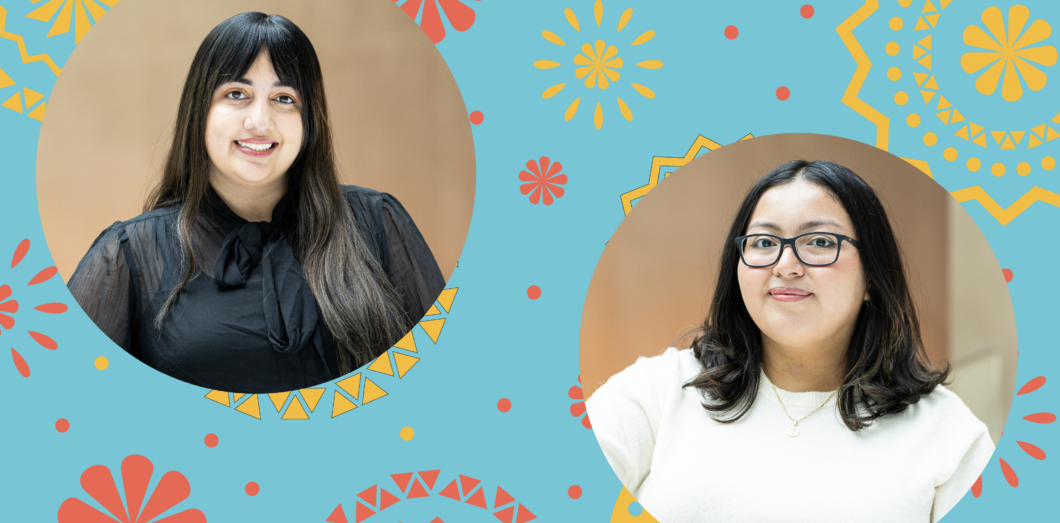
María Ángel
Audiology Student
University of Illinois Urbana-Champaign
VP for Planning, National NSSLHA
María Ángel is a fourth-year Doctor of Audiology (AuD) student at the University of Illinois Urbana-Champaign. She serves as the Vice President for Planning on the National NSSLHA Executive Council and is a co-chair of the National NSSLHA IDEA Work Group. María is passionate about advancing culturally and linguistically responsive care in audiology, with particular interests in bilingual populations and addressing hearing healthcare disparities within Hispanic and Latino communities. Following her externship, she plans to continue her doctoral training at the University of Illinois to pursue a PhD.

Hailey Carrasco
Speech-Language Pathology Student
University at Buffalo
Vice President for Programming (SLP)
Hailey Carrasco is a graduate student in the Speech-Language Pathology program at the University at Buffalo. She currently serves as the Vice President for Programming (SLP) on the National NSSLHA Executive Council. Hailey is passionate about multilingual service delivery in medical settings and empowering students in communication sciences and disorders.
As two Latina graduate students pursuing careers in communication sciences and disorders (CSD), Hispanic Heritage Month gives us an opportunity to reflect on the experiences, cultures, and communities that have shaped our journeys. Although we are pursuing different paths—one in speech-language pathology and one in audiology—our identities have influenced how we view our roles as future clinicians, advocates, and professionals.
For us, Hispanic Heritage Month is not only a celebration of our culture and heritage but also an opportunity to recognize the importance of representation within our professions. In this blog post, we share our experiences finding our paths in CSD, navigating our identities as Latina students, and thinking about how we hope to serve our communities. We also highlight ways that CSD programs, professionals, and students can help create a field where Hispanic and Latino students feel represented, supported, and empowered to succeed.
Why did you choose this field? What experiences did you have that led you to this path?
Hailey
I have always been drawn to health care, as I have always loved being amidst the busy environment, meeting new people, and helping others who are sick. Growing up, I would go with older relatives to appointments to help them translate. My grandmother also experienced a traumatic brain injury and required treatment for swallowing and language from a speech-language pathologist (SLP) during her inpatient stay.
Growing up, I was taught the importance of oral history. Telling stories and breaking bread were two experiences that were very important to those in my community. I also grew up in New York City, so I was always exposed to people from diverse linguistic and cultural backgrounds. I developed an appreciation for language and speech—and how sharing a language can create common ground and connection between strangers.
I decided that I would help others communicate, speak, and swallow—as well as help individuals who speak languages other than English receive adequate care for communicative disorders.
María
Growing up, I always knew that I wanted a career where I could help others, but I did not always know that audiology would be that path. As a native Spanish speaker and first-generation college student, I became interested in the ways that language, culture, and access to health care can shape a person’s experiences.
During my undergraduate education, I was introduced to audiology and quickly became fascinated by the combination of health care, technology, communication, and the opportunity to build meaningful relationships with patients and families. As I gained more clinical and research experience, I also became increasingly aware of the barriers that Hispanic and Latino communities can face when accessing hearing health care. I began to see how my own background could be an asset in the profession—and how important it is for patients and families to receive care that considers not only their language but also their culture, experiences, and values. These experiences ultimately shaped my research interests in working with hearing health disparities and bilingual populations and strengthened my goal of becoming a bilingual audiologist and researcher.
How has your identity as a Hispanic/Latino student in CSD been challenged? What obstacles have you faced on your path toward becoming a clinician? Were there any feelings of isolation or imposter syndrome?
Hailey
As a future SLP, I want to ensure that my community is truly represented in the field of CSD and, in turn, to make sure that others in my community feel represented culturally and linguistically. However, as the only Hispanic student in my cohort, it felt isolating and made me question my place in my program. I also found it difficult to gain more experience working with multilingual clients and patients, especially since it was one of my career interests.
I eventually grew to believe that, in order to prove that I belonged, I needed to do it all. I took on every opportunity that was in front of me, even if I was stretching myself thin. I felt that if I could prove myself in different ways, I would feel like I fit and belonged.
Coming into graduate school, I had to shift my mindset from “Do I belong here?” to “I am in the room; I do belong.” I found support from my cohort and from mentors, who embraced what made me different and what I valued. I continue to remind myself that, even though I may feel isolated at times, I still belong and will make an impact on my community in my career.
María
As a Latina and native Spanish speaker pursuing audiology, my identity has been both a source of pride and something that I have had to navigate throughout my education. There have been many times when I have been one of the only—or one of very few—Hispanic students in an academic, a clinical, or a professional space. Being in spaces where few people share your cultural or linguistic background can sometimes make you question whether you truly belong there.
Imposter syndrome has been something I have experienced throughout my journey, especially when entering new spaces or taking on opportunities that pushed me outside of my comfort zone. At times, I have questioned whether I was qualified enough, experienced enough, or even whether I belonged in the room. In those moments, I have had to remind myself to be persistent and remember how far I have already come. I have learned that feeling uncomfortable or unsure does not mean that I do not belong; sometimes, it simply means that I am growing and entering spaces that were not always created with people who look or sound like me in mind.
One thing that has continued to motivate me is reminding myself that representation matters. When I find myself questioning whether I belong in a particular space, I think about the students who may come after me and the patients and families who may one day see a part of themselves represented in their audiologist. I know how meaningful it can be to see someone with a similar background succeeding in a space where you may not see many people like yourself. That reminder has helped me continue to show up, seek opportunities, and advocate for myself—even when doing so feels intimidating.
How do you hope to serve your community after graduation? Why is it important to serve said community? What, if anything, will you do to encourage other Hispanic/Latino individuals to join the field of CSD?
Hailey
I want to get more experience working with Spanish-speaking patients and taking online courses in Spanish in health care to provide speech, language, and swallowing services in Spanish. I want to ensure that my patients get the treatment they need in their preferred language as well as be able to provide education and recommendations to my patients. I also plan to advocate for more resources for individuals who speak languages other than English—such as providing interpreters to rural communities and creating physical documents in multiple languages that we can provide to patients. It’s important to serve not only the Hispanic and Spanish-speaking community but all patients of diverse linguistic and cultural backgrounds—because we have an obligation as clinicians to provide appropriate care to patients and ensure that they fully understand the evaluations and treatments that they are undergoing.
One thing I hope to do is encourage more Spanish speakers to join the CSD field. According to ASHA’s year-end 2024 data, only 8.6% of ASHA constituents self-identified as multilingual service providers. Among those providers, 67.7% offered services in Spanish. Meanwhile, according to Pew Research Center, Hispanic and Latino people make up approximately 20% of the U.S. population, and 68% of Latinos ages 5 and older speak Spanish at home. These figures underscore the need for more clinicians who can provide services in Spanish—as well as more opportunities for all clinicians to develop the skills needed to serve multilingual populations.
María
After graduation, I hope to serve Hispanic and Latino communities through both my clinical work as an audiologist and my research. As a native Spanish speaker, I hope to provide hearing health care in Spanish and help patients and families feel comfortable, understood, and involved in decisions about their care. I also want to contribute to research addressing hearing health disparities and help develop more culturally and linguistically appropriate resources and clinical practices.
It is important to me to serve this community because representation matters—especially in health care. At the same time, I recognize that Hispanic and Latino communities are incredibly diverse, and sharing a language or cultural background does not mean sharing the same experiences. I also hope to encourage more Hispanic and Latino students to pursue careers in audiology, speech-language pathology, and CSD through participating in mentorship, engaging in outreach, and sharing my own experiences.
Building Support
Drawing from both of our experiences, we believe that CSD programs and professionals can take several steps to build support in Hispanic/Latino students and communities:
- Provide opportunities for students to work with multilingual populations (e.g., being employed by multilingual schools, working for an independent multilingual private practice, marketing our services to diverse populations)
- Ensure that formal assessments are available in both Spanish and English.
- Don’t just rely on informal assessments for Spanish patients (e.g., QAB, Dial, etc.)
- Train staff on working with interpreters.
- Identify and secure methods of interpretation prior to patients’ arrival.
- Don’t wait for a Spanish-speaking patient to make an appointment before you start thinking about your office’s ability to provide interpretive services. Make a plan beforehand!
- Increase recruitment and mentorship of Hispanic/Latino students beginning before graduate school—including outreach to undergraduate and even high school students. Play a proactive role in increasing people’s awareness of audiology and speech-language pathology as career options. Many students simply may not encounter these professions before college.
- Recognize cultural responsiveness as an ongoing responsibility rather than something expected primarily from clinicians who are multilingual or from historically underrepresented backgrounds.
What can students do if they need more support?
- Look for mentorship opportunities through ASHA organizations (e.g., the Hispanic Caucus, Student to Empowered Professional Mentoring Program [S.T.E.P.]).
- Connect with multicultural groups in your university, if available.
- Seek mentorship in professors, or ask professors to connect you to mentors with similar clinical interests/experiences.
- Seek mentors both within and outside your university. Your mentor does not necessarily have to share your identity to support you effectively.
- Find community outside of your program if you don’t have that representation within your cohort or department.
- Remember that you do not have to navigate graduate school alone or already know how everything works. Asking for mentorship and support is a strength.